Solana Rug Pull Data: Detecting Rug Pulls and Insider Wallets On-Chain
How a Pump.fun rug pull and the insider wallets behind it show up in on-chain Solana data: the published numbers and what they measured, the exact rules that label rugs, insiders and risk scores, queries that run as written, and the limits no on-chain signal can get past.
Solana rug pull data is the on-chain record of a token being emptied by the people who launched it: the creator or a wallet close to the creator sells a large position, and the price collapses within minutes. On Pump.fun, where most Solana memecoins start, that record is unusually complete. Every launch, every buy in the launch slot, every wallet whose account the creator paid for, and every sale into a falling price is a transaction anyone can read.
What the data cannot record is intent. A wallet that bought in the launch slot may be the creator's second wallet or a fast bot with no connection to the creator. A creator who sells 90% of their tokens may be running an exit scam or taking profit on a token that was always a joke. Every rug-pull figure you will read rests on rules that turn behavior into a label, and the rules decide the answer.
This guide explains what a rug pull looks like on Solana, where the widely quoted numbers come from, how the Rug Pull Detection, Insider Wallet Detection and Token Risk Scores datasets define each label, and how to query them. It ends with what on-chain signals can and cannot tell you, which matters most if you plan to train a model on these labels.
What Counts as a Rug Pull on Solana
Solana tokens all run on the shared SPL Token program (or Token-2022), so a rug pull is not usually hidden in malicious contract code, as it often is on Ethereum. It is a pattern of behavior. A March 2026 study of confirmed Solana rug pulls groups them into three patterns (Chen et al., arXiv 2603.24625):
| Pattern | What happens | Where it shows up |
|---|---|---|
| Freeze authority abuse | The issuer keeps the power to freeze holder accounts, so buyers cannot sell | Mint and freeze authorities: Token Authority Risk Monitoring |
| Liquidity withdrawal | The pool owner removes liquidity, leaving holders with nothing to sell into | Pool LP burns and locks: LiquidityLocks in Token Risk Scores, Liquidity Lock Registry |
| Pump-and-dump | Insiders accumulate early, the price rises, and they sell into the buyers | Launch-slot and early buys, insider sales: Insider Wallet Detection, Rug Pull Detection |
A Pump.fun token adds a constraint. While it trades on its bonding curve, the reserves sit in the Pump.fun program, not in a pool the creator owns, so there is no liquidity for the creator to pull. On Pump.fun the rug is almost always the third pattern: a sale. That is why the datasets below define a rug by who sold and what happened to the price, not by liquidity removal.
The Published Numbers and What Each Measured
Three figures are quoted most often. They do not measure the same thing.
| Figure | What it measured | Source |
|---|---|---|
| 98.6% of Pump.fun tokens | Tokens created January 2024 to March 2025 that ended with under $1,000 of liquidity in SOL, described as showing pump-and-dump or rug-pull characteristics. The report's own pages also give 98.7%. Pump.fun publicly disputed it. | Solidus Labs, May 2025; CoinDesk |
| 76,469 of 100,063 new tokens | Tokens on Orca, Raydium and Meteora in the first half of 2025 flagged by a detector built from 117 confirmed cases, with an estimated 0.26% false-positive rate in a 382-token audit | Chen et al., arXiv 2603.24625 |
| 36.5% of supply | Average share of a launch's supply held by accounts linked as one entity, across 41,000+ launchpad launches | MELT dataset, arXiv 2602.13480 |
The first figure counts tokens that died. Most memecoins die without anyone stealing from anyone, so "fell below $1,000 of liquidity" is an upper bound on fraud, not a measure of it. The second counts tokens matching behavioral patterns on DEX pools, after Pump.fun. The third does not count rugs at all; it measures how much supply is held by coordinated wallets, which is a precondition for one.
Before you quote any rug rate, say which of these you mean: tokens that failed, tokens that matched a rug pattern, or tokens with a concentrated insider position.
How a Rug Pull Appears in the Data
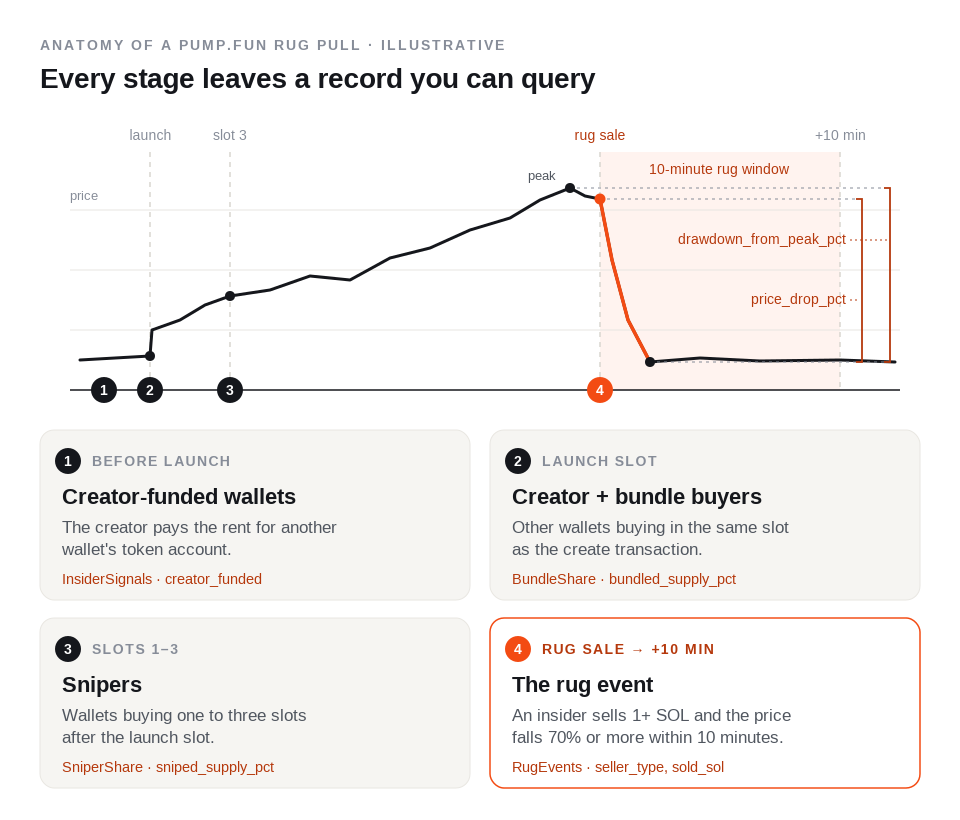
The Rug Pull Detection dataset uses one explicit rule. A rug is recorded when:
- the seller is the token's creator or a launch insider (a bundle buyer, a sniper, or a wallet the creator funded, defined in the next section);
- that seller receives at least 1 SOL from sales within a 10-minute window; and
- the price falls 70% or more from the trade before the sale. Trades under 0.01 SOL are ignored so that dust trades cannot set the price.
Each detected rug is one row in RugEvents:
| Column | What it holds |
|---|---|
mint, symbol, creator | The token and who created it |
seller, seller_type | The wallet behind the rug sale: creator, bundle_buyer, sniper or creator_funded |
rug_ts, sig, venue | When it happened, the transaction, and whether it was on the bonding curve (pumpfun) or after graduation (pumpswap) |
sold_sol | SOL the seller received in the 10-minute window |
price_drop_pct | Fall from the price before the sale to the lowest price within 10 minutes |
drawdown_from_peak_pct | Fall from the all-time peak to that same low |
minutes_after_launch | Time from launch to the rug sale |
holders_before | Wallets that had bought and not fully sold before the rug |
RugDaily rolls this up to one row per UTC day: tokens traded, rugs detected, the rug rate, SOL extracted and the median minutes to rug. Its first and last date define the window in which rugs were tracked. Read that window before comparing a rate with anything else.
Two of the rule's choices change the numbers more than any other: the 70% threshold and the requirement that the seller be an insider. A token that falls 90% because unconnected early buyers sold is not a rug under this rule. A creator who sells slowly over an hour never triggers the 10-minute window. Both are deliberate: the rule is meant to catch the fast, insider-driven exit, not every token that failed.
Who Counts as an Insider
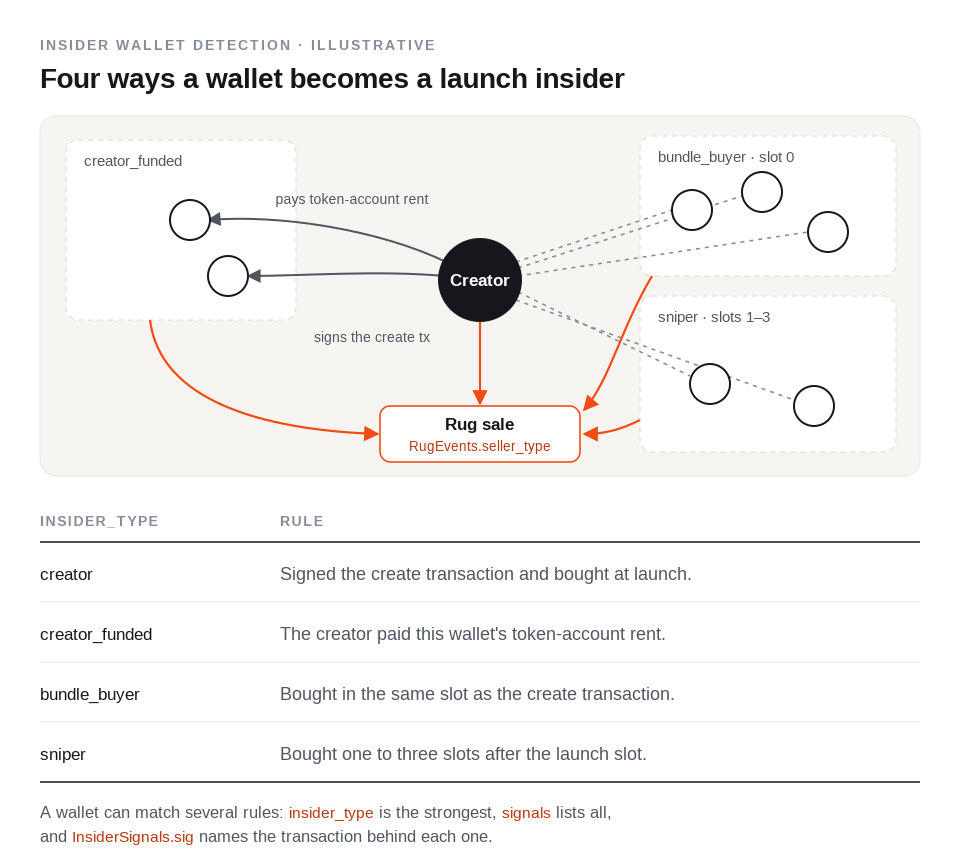
Insider Wallet Detection looks at the first 24 hours of each Pump.fun token and labels a wallet an insider if it matches any of four signals:
insider_type | Rule | Evidence |
|---|---|---|
creator | Signed the create transaction and bought at launch | The create transaction |
creator_funded | The creator paid the rent for this wallet's token account | The rent payment |
bundle_buyer | Bought in the same slot as the create transaction | The buy, in the launch slot |
sniper | Bought one to three slots after the launch slot | The buy, with its slot offset |
A wallet can match more than one rule. insider_type holds the strongest, the full list is in signals, and InsiderSignals keeps one row per signal with the transaction that shows it (sig) and a plain description (detail). That evidence trail matters: anyone checking a label can open the transaction and see what the rule saw.
Two refinements keep the labels honest. A funder that pays rent for more than 50 wallets of the same token is treated as a service or an airdrop, not an insider, and is ignored. And InsiderSellOff aggregates each token's insiders into one row: the share of supply they bought, the share they sold within 24 hours, SOL in and out, and how many seconds after launch the first insider sold.
The weakest of the four signals is sniper. Fast public bots buy in the first few slots of many launches with no connection to the creator. Treat sniper-only wallets as "early and fast," not as proof of coordination, and check them against Bot Detection, which flags wallets that make many Pump.fun buys within two slots of launch.
Scoring Risk Before a Rug
A rug label arrives after the damage. Token Risk Scores is the forward-looking companion: a published, rule-based score from 0 (low risk) to 100 (high risk) for every Pump.fun token, built from seven factors whose points add up to 100.
| Factor | Measures | Max points |
|---|---|---|
bundled_supply | Supply bought in the launch slot by wallets other than the creator | 20 |
top10_concentration | Share of supply held by the 10 largest wallets | 20 |
sniped_supply | Supply bought one to three slots after launch | 15 |
creator_sold | How much of their own purchase the creator sold | 15 |
insider_funding | Wallets whose token accounts the creator paid for | 10 |
lp_not_burned | For graduated tokens, whether the PumpSwap pool's LP tokens were burned | 10 |
dead_24h | No trades after the first 24 hours | 10 |
Scores fall into three bands: low under 30, medium 30 to 59, high 60 and above. RiskFactors keeps one row per token per factor, with the measured value, the threshold at which it scores full points, and the points it added, so every score can be taken apart. rule_version records which version of the rules produced it, and scored_at records the end of the scoring window.
Three of the factors (creator_sold, dead_24h and, partly, top10_concentration) can only be measured after events that a rug itself causes. That makes the score a good description of a token and a poor predictor, unless you are careful about timing. The queries below show how.
Querying Rug Pull and Insider Data
The queries below run as written in DuckDB against the delivered layout, solana/token/<dataset>/schema=v1.0/<table>/…. The ** glob reads every partition of a table, whichever way it is partitioned. They were checked against the free samples of each dataset.
Rugs by who sold and where
SELECT seller_type,
       venue,
       count(*)                       AS rugs,
       median(sold_sol)               AS median_sol_received,
       median(minutes_after_launch)   AS median_minutes_after_launch,
       median(price_drop_pct)         AS median_price_drop_pct
FROM read_parquet('solana/token/rug_pull_detection/schema=v1.0/rug_events/**/*.parquet')
GROUP BY ALL
ORDER BY rugs DESC;
Splitting by venue separates rugs on the bonding curve from rugs after graduation. They are different events: a curve rug hits buyers before the token has a pool, a PumpSwap rug hits a token that had already "made it."
Did insiders sell before the rug?
WITH rugs AS (
  SELECT mint, min(minutes_after_launch) * 60 AS rug_seconds
  FROM read_parquet('solana/token/rug_pull_detection/schema=v1.0/rug_events/**/*.parquet')
  GROUP BY mint
)
SELECT count(*)                                                    AS rugged_tokens,
       median(o.insider_supply_pct)                                AS median_insider_supply_pct,
       median(o.insider_sold_pct)                                  AS median_insider_sold_pct,
       median(o.insider_profit_sol)                                AS median_insider_profit_sol,
       count(*) FILTER (WHERE o.first_insider_sell_seconds < r.rug_seconds) AS insiders_sold_first
FROM rugs r
JOIN read_parquet('solana/token/insider_wallet_detection/schema=v1.0/insider_sell_off/**/*.parquet') o
  USING (mint);
insiders_sold_first counts tokens where an insider was already selling before the sale that triggered the rug. A high share suggests the visible rug is the end of an exit, not the start.
Does the risk band predict a rug?
WITH window_days AS (
  SELECT min(date) AS first_day, max(date) AS last_day
  FROM read_parquet('solana/token/rug_pull_detection/schema=v1.0/rug_daily/**/*.parquet')
),
scores AS (
  SELECT s.mint, s.risk_band, s.scored_at
  FROM read_parquet('solana/token/token_risk_scores/schema=v1.0/token_risk_scores/**/*.parquet') s,
       window_days w
  WHERE s.created_ts::DATE BETWEEN w.first_day AND w.last_day
),
first_rug AS (
  SELECT mint, min(rug_ts) AS rug_ts
  FROM read_parquet('solana/token/rug_pull_detection/schema=v1.0/rug_events/**/*.parquet')
  GROUP BY mint
)
SELECT s.risk_band,
       count(*)                                                    AS tokens,
       count(r.mint)                                               AS rugged_any_time,
       count(r.mint) FILTER (WHERE r.rug_ts > s.scored_at)         AS rugged_after_scoring,
       round(100.0 * count(r.mint) FILTER (WHERE r.rug_ts > s.scored_at) / count(*), 2)
                                                                   AS pct_rugged_after_scoring
FROM scores s
LEFT JOIN first_rug r USING (mint)
GROUP BY s.risk_band
ORDER BY CASE s.risk_band WHEN 'low' THEN 1 WHEN 'medium' THEN 2 ELSE 3 END;
Two details make this query fair. Tokens are limited to those created inside the rug-tracking window, so a token is never counted as "not rugged" just because nobody was watching. And only rugs after scored_at count as predicted: a rug inside the scoring window has already pushed up creator_sold, so counting it would let the score take credit for the event it measured.
The evidence trail for one token
SELECT wallet, signal, ts, detail, sig
FROM read_parquet('solana/token/insider_wallet_detection/schema=v1.0/insider_signals/**/*.parquet')
WHERE mint = '<mint address>'
ORDER BY ts;
Run this before you publish a claim about a specific token. Every row names the transaction behind the label, so the claim can be checked by anyone with a block explorer.
Concentration the day before the rug
WITH rugs AS (
  SELECT mint, min(rug_ts)::DATE AS rug_day
  FROM read_parquet('solana/token/rug_pull_detection/schema=v1.0/rug_events/**/*.parquet')
  GROUP BY mint
)
SELECT median(c.top10_pct)    AS median_top10_pct,
       median(c.creator_pct)  AS median_creator_pct,
       median(c.gini)         AS median_gini,
       count(*)               AS tokens_with_snapshot
FROM rugs r
JOIN read_parquet('solana/token/holder_concentration_analytics/schema=v1.0/concentration_daily/**/*.parquet') c
  ON c.mint = r.mint AND c.snapshot_date = r.rug_day - INTERVAL 1 DAY;
Holder Concentration Analytics measures shares over wallet-held supply and reports the bonding curve and pool separately in curve_pool_pct. Without that separation, the curve looks like the largest holder of every young token. Many rugs happen within minutes of launch, before any end-of-day snapshot exists, so tokens_with_snapshot will be smaller than the number of rugs. Report both.
What On-Chain Data Cannot Tell You
Every label above is a rule applied to behavior. Know where the rules stop before you publish a number or train a model on them.
- Intent. A creator selling 90% of their supply in ten minutes is recorded the same way whether it was planned fraud or a panicked exit. The data proves the sale, not the motive.
- Funding outside token-account rent. Insider funding is detected from token-account rent the creator paid. Plain SOL transfers from a creator to a fresh wallet are not visible yet, and neither is funding that passes through an exchange or several hops. The Wallet Funding Graph is partial for the same reason. Treat
creator_fundedcounts as a floor. - Off-chain coordination. Group chats, paid callers and influencer promotion leave no on-chain trace until the trades happen.
- Fast bots that are not insiders. Sniper and bundle-buyer labels catch speed. Without a funding link, speed alone does not prove a connection to the creator.
- Slow exits. A creator who sells gradually over days never meets a 10-minute, 70% rule. That is a choice about what to call a rug, not an error, but it means a rug count is not a count of every insider exit.
- Non-Pump.fun tokens. These datasets cover Pump.fun tokens, on the bonding curve and after graduation to PumpSwap. Tokens launched directly on other DEXs need the DEX-pool patterns in the research above.
Using These Labels for Machine Learning
Rug and insider labels are attractive training targets, and easy to misuse. Three rules prevent most of the damage:
- Split by time, not at random. Launch styles and bot behavior change from month to month. A random split puts tomorrow's tokens in the training set. Train on earlier launch dates and test on later ones.
- Build features from the window before the label. If the label is "rugged within 24 hours," features may only use data up to the moment of prediction.
creator_sold,dead_24hand the rug's ownprice_drop_pctare outcomes, not inputs. - Record the rule versions.
rule_versionin Token Risk Scores and the schema version in each path tell you which rules produced a label. A model trained on one version and evaluated on another is measuring the change in rules.
The same discipline applies to backtests. Our guide to building a backtesting dataset without look-ahead bias covers it in more detail.
Checklist Before Publishing a Rug Pull Number
- Name the definition. Failed token, matched rug pattern, or insider sale with a price collapse.
- State the window. Take the rug-tracking window from
RugDaily's first and last date; insider signals cover each token's first 24 hours, and scores have their ownscored_at. - Restrict the denominator to tokens created inside the window you observed.
- Separate venues. Bonding-curve rugs and PumpSwap rugs are different events.
- Separate signal strength. Report creator and creator-funded sellers apart from snipers.
- Keep the evidence. Link the transactions behind any claim about a named token.
- Say what is not visible: plain SOL funding, off-chain coordination, slow exits.
Frequently Asked Questions
What is Solana rug pull data?
Solana rug pull data is the on-chain record of tokens emptied by their creators or launch insiders: who sold, how much SOL they received, how fast the price fell, and which wallets were connected to the launch. On Pump.fun it is built from token creations, early buys, account-rent payments and trades.
How do you detect a rug pull on Pump.fun?
Look for a large sale by the creator or a launch insider followed by a price collapse. The Rug Pull Detection dataset records a rug when such a seller receives at least 1 SOL within 10 minutes and the price falls 70% or more from the trade before the sale.
What is a bundled launch on Solana?
A bundled launch is one where other wallets buy in the same slot as the token's create transaction, often submitted together with it. Bundle buyers often belong to the creator. Token Risk Scores reports the share of supply they bought as bundled_supply_pct.
Are 98% of Pump.fun tokens rug pulls?
No study shows that. The widely quoted 98.6% figure from Solidus Labs counts Pump.fun tokens that ended with under $1,000 of liquidity, which includes tokens that simply failed. Pump.fun disputed the report. Rug rates based on insider sales and price collapse are a different, narrower measure.
Can on-chain data prove a wallet is an insider?
It can prove the behavior that defines the label, such as buying in the launch slot or having token-account rent paid by the creator, and it names the transaction. It cannot prove intent or detect coordination that happened off-chain or through funding paths it does not yet see.
Where can I get Solana rug pull and insider wallet data?
You can derive it yourself from decoded Pump.fun and token-account data, or use prepared datasets. datastore.sh delivers Rug Pull Detection, Insider Wallet Detection and Token Risk Scores as Parquet, with free samples of every table and the rules behind each label documented on the dataset page.
Sources
- Solidus Labs: The 2025 Rug Pull Report · 98.6% to 98.7% of Pump.fun tokens, January 2024 to March 2025, under $1,000 of liquidity; 93% of Raydium pools
- CoinDesk: 98% of tokens on Pump.fun have been rug pulls or fraud, report says · coverage of the report and Pump.fun's response
- Chen et al., From Hype to Collapse: Investigating Rug Pull Scams on Solana, arXiv 2603.24625 · three rug-pull patterns, 117 confirmed cases, 76,469 of 100,063 tokens flagged in the first half of 2025
- MELT: A Behavioral Trace Dataset for High-Risk Memecoin Launch Detection, arXiv 2602.13480 · 41,000+ launches, 36.5% average supply held by coordinated accounts
Datasets in this post
Dataset · SolanaRug Pull Detection2 tables · schema v1.0 · from $200Dataset · SolanaInsider Wallet Detection3 tables · schema v1.0 · from $200Dataset · SolanaToken Risk Scores6 tables · schema v1.0 · from $200Dataset · SolanaHolder Concentration Analytics1 tables · schema v1.0 · from $200Dataset · SolanaWallet Funding Graph2 tables · schema v1.0 · from $200Data Platform
datastore.sh engineering
The team that operates capture, decoding, and reconciliation for every dataset in the catalog.